

DIRECT IMAGING
Taking Pictures
82 planets discovered
Astronomers can take pictures of exoplanets by removing the overwhelming glare of the stars they orbit
Exoplanets are far away, and they are millions of times dimmer than the stars they orbit. So, unsurprisingly, taking pictures of them the same way you'd take pictures of, say Jupiter or Venus, is exceedingly hard.
New techniques and rapidly-advancing technology are making it happen.
The major problem astronomers face in trying to directly image exoplanets is that the stars they orbit are millions of times brighter than their planets. Any light reflected off of the planet or heat radiation from the planet itself is drowned out by the massive amounts of radiation coming from its host star. It's like trying to find a flea in a lightbulb, or a firefly flitting around a spotlight.
Shine blockers
On a bright day, you might use a pair of sunglasses, or a car's sun visor, or maybe just your hand to block the glare of the sun so that you can see other things.
This is the same principle behind the instruments designed to directly image exoplanets. They use various techniques to block out the light of stars that might have planets orbiting them. Once the glare of the star is reduced, they can get a better look at objects around the star that might be exoplanets.
Building a light-blocker
There are two main methods astronomers use to block the light of a star.
One, called coronography, uses a device inside a telescope to block light from a star before it reaches the telescope's detector. Coronagraphs are built as internal add-ons to telescopes, and are now being used to directly image exoplanets from ground-based observatories.

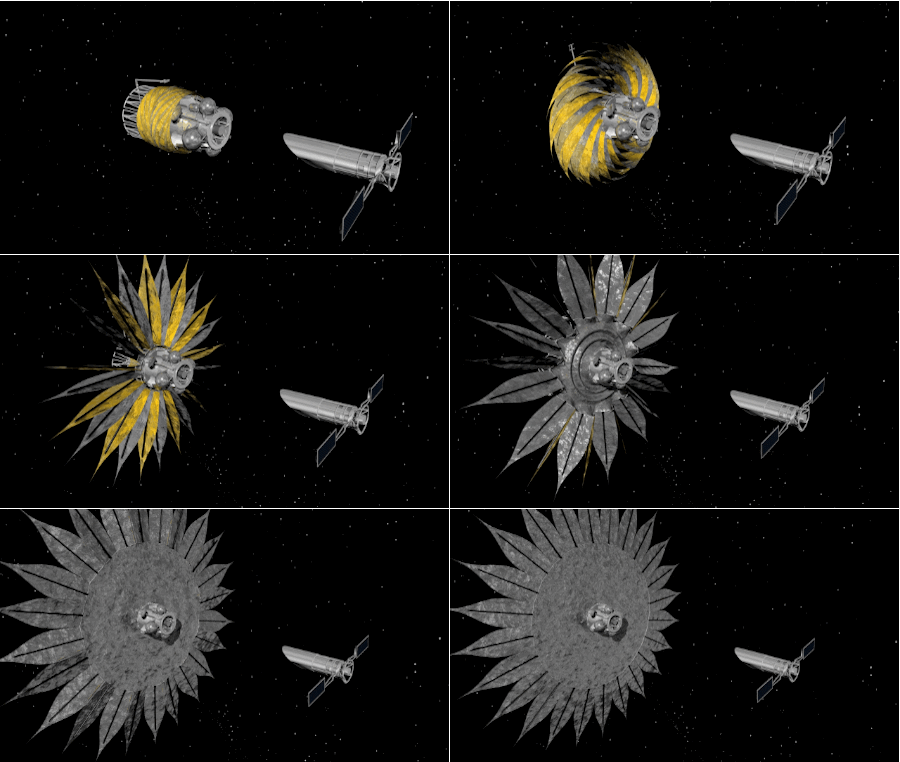
Another method is to use a 'starshade', a device that's positioned to block light from a star before it even enters a telescope. For a space-based telescope looking for exoplanets, a starshade would be a separate spacecraft, designed to position itself at just the right distance and angle to block starlight from the star astronomers were observing.
Way of the future
Direct imaging is still in its beginning stages as an exoplanet-finding method, but there are high hopes that it will eventually be a key tool for finding and characterizing exoplanets. Future direct-imaging instruments might be able to take photos of exoplanets that would allow us to identify atmospheric patterns, oceans, and landmasses.