

GRAVITATIONAL MICROLENSING
Light in a Gravity Lens
225 planets discovered
Light from a distant star is bent and focused by gravity as a planet passes between the star and Earth
Among his many insights, Albert Einstein rethought the concept of gravity, defining it less as a mysterious attraction between objects and more as a geometric property of spacetime.
In other words, big objects warp the fabric of space. This effect causes light to distort and change direction when affected by the gravity of a massive object, like a star or a planet.
Bending for brightness
This change of direction can cause some pretty interesting things to happen. Sometimes, gravity can bend and focus light like a lens in a magnifying glass or pair of glasses.
Gravitational microlensing happens when a star or planet's gravity focuses the light of another, more distant star, in a way that makes it temporarily seem brighter.
In the animation above, you can see the rays of light from the more distant star bend around the exoplanet and then the exoplanet's star. In the same way that a magnifying glass can focus the sun's light onto a tiny, very bright spot on a piece of paper, the gravity of the planet and the star focus the light rays of the distant star onto the observer.
The graph on the left indicates the changing brightness of the distant star as its light is lensed and focused onto the observer. The star starts to get brighter, then there's a brief blip of brightness from the lensing action of the planet.
The light levels fall after the planet is lensed but they continue to increase because of the continued lensing action of the star. Once the lensing star moves out of the optimum position, the brightness of the more distant star fades away.
A fleeting flash of light
Direct imaging is still in its beginning stages as an exoplanet-finding method, but there are high hopes that it will eventually be a key tool for finding and characterizing exoplanets. Future direct-imaging instruments might be able to take photos of exoplanets that would allow us to identify atmospheric patterns, oceans, and landmasses.
Astronomers can't predict when or where these lensing events will happen. So they have to watch large parts of the sky over a long period of time. When they record a star getting brighter and then dimming in the pattern of lensing objects, they analyze the data to get information about the estimated size of the star.
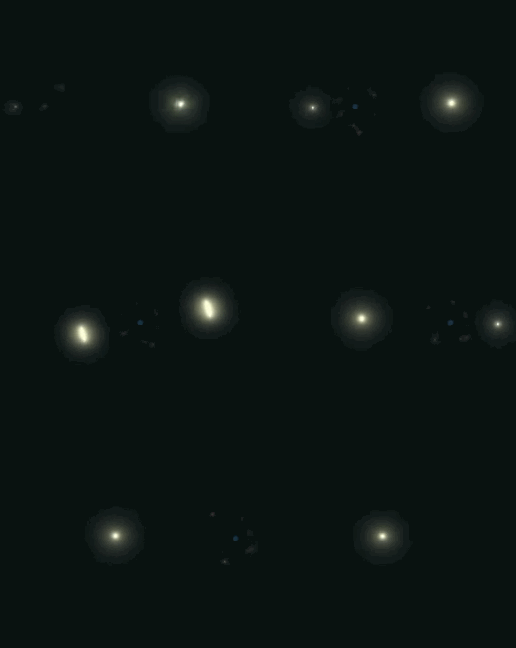
Sometimes, free-floating planets in space, ones that don't orbit a star, will cause quick microlensing events that astronomers will record. These events give us an idea of how common these so-called 'rogue' planets are in the galaxy. The animation on the right shows what that kind of event looks like to a telescope.